
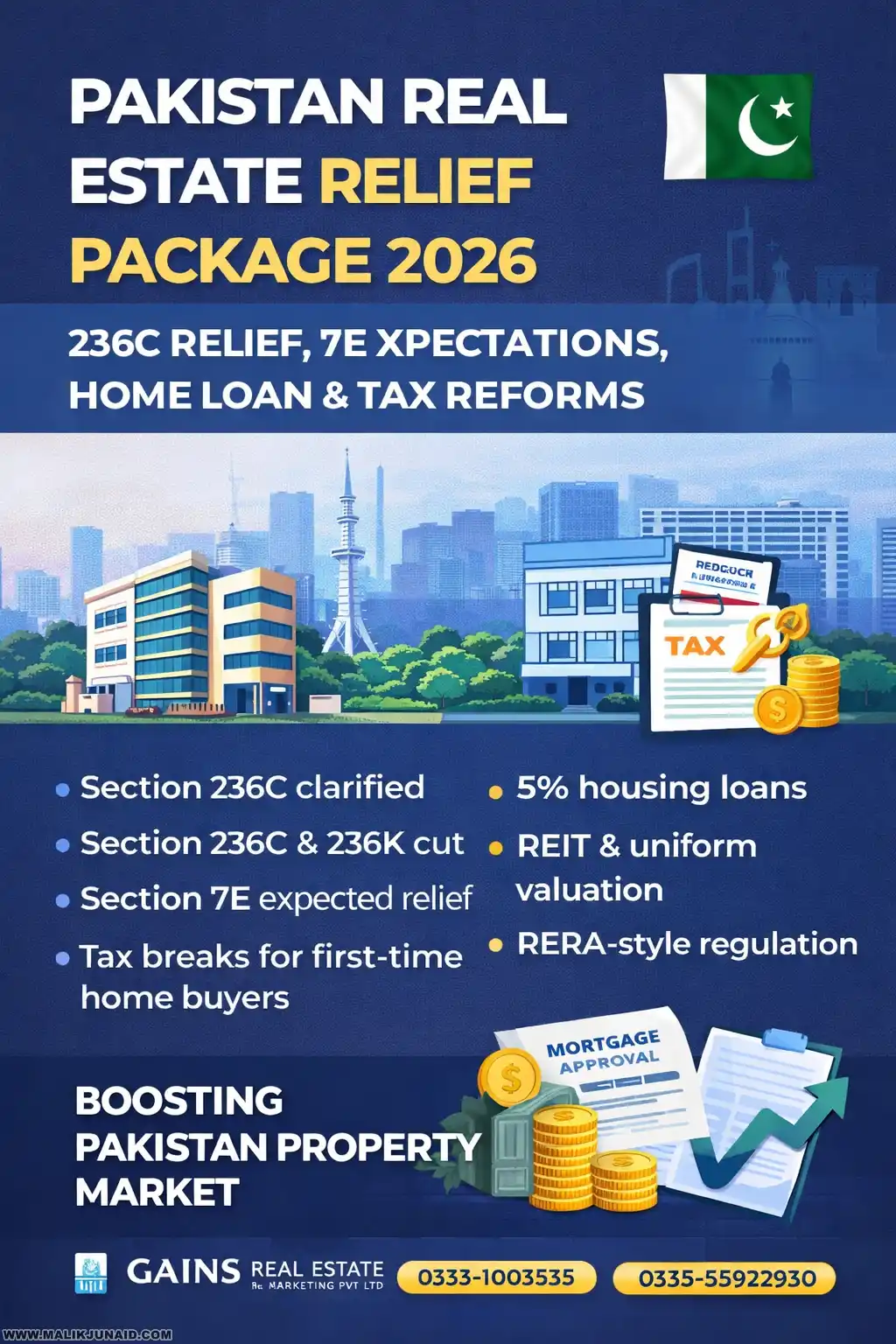
Pakistan Real Estate Relief Package 2026: Why Section 236C Clarification and Expected Tax Reforms Could Revive the Property Market
Pakistan’s real estate and construction sector may be entering one of its most important policy transition periods in recent years. The latest signal comes from the Federal Board of Revenue (FBR), which has issued a circular clarifying the applicability of withholding tax under Section 236C for persons covered under Section 7F of the Income Tax Ordinance, 2001. According to the circular, builders and developers taxed under Section 7F who do not have any other taxable source of income may seek exemption from collection of advance tax under Section 236C, subject to approval through the relevant Commissioner Inland Revenue.
This clarification matters because it directly addresses a long-standing complaint in Pakistan’s property and construction market: double taxation and unnecessary liquidity pressure on builders and developers already operating under a fixed or special tax regime. In simple words, if a person is already being taxed under Section 7F on a project basis, then collecting additional advance tax under Section 236C on sale transactions can create an avoidable burden that later requires adjustment or refund. The FBR’s latest position is therefore being seen as a meaningful policy correction for the real estate ecosystem.
At the same time, the market is also discussing a wider Pakistan real estate relief package 2026. These proposals include no 7E, lower transaction taxes under 236C and 236K, relief for first-time home buyers, exemptions up to one kanal for certain owner-occupied properties, lower tax friction for overseas Pakistanis, more affordable housing finance, stronger mortgage infrastructure, developer-led financing models, REIT expansion, RERA-style regulation, and more realistic property valuation aligned with market rates. Some of these changes are still expected rather than officially notified, so they should be viewed as policy proposals and not final law yet. Recent reporting indicates there is a strong policy discussion around reducing property transaction taxes further, but formal enactment would require notification, legal amendments, or budget approval where applicable.
Why the FBR’s Section 236C clarification is such a big deal
The circular attached to your topic is important because it addresses a very practical issue for the real estate sector. Under Section 7F, certain builders and developers are taxed under a fixed or special regime on a project basis. The FBR has now clarified that such persons, where they have no other taxable income, may apply for exemption from collection of advance tax under Section 236C. This reduces the cash-flow stress created by advance tax collection on property sale transactions.
For the market, this has three immediate implications.
First, it reduces the feeling of a double tax regime for qualifying builders and developers. Second, it can improve project liquidity because less capital remains blocked in advance tax and refund cycles. Third, it sends a broader signal that policymakers are listening to the real estate and construction industry’s concerns. That is especially relevant in Pakistan, where housing and construction have long been treated as growth multipliers. The State Bank of Pakistan has itself noted that housing and construction are closely tied to at least 40 allied industries, underlining the wider economic importance of this sector.
The bigger reform conversation: what the market expects in 2026
Beyond the FBR circular, there is strong discussion in the market around a broader property tax relief and housing stimulus package. Some proposals being discussed include:
- No financial monitoring in case of overseas remittances for property-related inflows
- No Section 7E
- Section 236C reduced to 1.5%
- Section 236K reduced to 0.5%
- No double tax regime
- Fixed tax for overseas investors
- No tax up to 1 kanal plot or house in certain cases
- No tax for first-time plot or home owner
- No tax on housing loan
- Introduction or strengthening of REIT, home loan at 5%, and RERA-style regulation
- Uniform property valuation closer to market rates
- Low-cost housing loans at 5%
- Mandatory bank lending targets
- Developer-led financing models
- Mortgage market development through bonds and stronger PMRC support
- Green mortgages and Takaful-based housing insurance
These measures are not all officially enacted today. However, they line up with policy directions already visible in Pakistan’s housing finance, mortgage development, and capital market regulation. For example, the State Bank has maintained housing and construction finance targets for banks, while PMRC has been positioned as a liquidity facility to support longer-term mortgage funding. SECP has also updated REIT regulations in 2026 to improve transparency, governance, and market development.
No financial monitoring in case of overseas remittances: why overseas Pakistanis matter
Overseas Pakistanis remain one of the most important demand segments for Pakistan property investment. FBR already provides a notable concession: eligible overseas Pakistanis holding POC or NICOP and meeting non-resident conditions can get filer rates on advance income tax under Sections 236C and 236K, even if they are technically non-filers.
If broader relief is introduced around reduced financial monitoring or simplified compliance for overseas remittances used in property transactions, it could further boost confidence among non-resident Pakistanis. That would be particularly important for high-potential urban and planned developments where overseas investors often look for transparency, ease of transfer, and predictable taxation.
For serious investors exploring opportunities, Gains Real Estate and Marketing Pvt Ltd can help evaluate available inventory, documentation flow, and investment suitability. You can call directly at 0333-1003535 or 0335-5592930, or message on WhatsApp at 0333-1003535 and 0335-5592930.
No 7E: why the market is demanding its removal
One of the strongest market expectations is the removal or rollback of Section 7E, which has been controversial because it taxes deemed income from capital assets in certain situations. For many investors, especially in a market already dealing with transaction taxes, valuation issues, and financing constraints, 7E has been seen as another deterrent to formal property activity.
A “no 7E” environment would likely improve transaction sentiment, reduce holding friction, and support documented property transfers. Even where immediate abolition does not happen, any narrowing of scope or practical relief for genuine homeowners and smaller investors would be viewed positively by the market.
Section 236C reduced to 1.5% and Section 236K reduced to 0.5%
One of the most talked-about proposals is the reduction in 236C and 236K. Recent reporting says there is a strong view within policy discussions to reduce the seller-side withholding tax under Section 236C and the buyer-side tax under Section 236K, though final rates would depend on official approval.
If 236C comes down to 1.5% and 236K to 0.5%, the market could respond quickly. Lower entry and exit costs generally encourage more documentation, more transactions, and better liquidity. Your point about applying only 30% of the 1.5% where property is sold within one year is part of the reform discussion being circulated in the market as a way to encourage short-term investment and faster churn in inventory, but that specific formula should be treated as a proposal until officially notified.
The real significance here is behavioral. Lower transaction taxes reduce dead cost, improve affordability, and help both end users and investors re-enter the market.
No double tax regime and fixed tax for overseas investors
The new FBR circular already moves in the direction of reducing double-tax treatment for those under Section 7F.
If this philosophy extends further into the tax framework, it could make Pakistan’s property market much easier to understand and far more investable.
Similarly, a fixed tax regime for overseas investors would be a smart move. Overseas buyers often prefer certainty over complexity. A simple, predictable tax structure can do more to attract remittances than a technically generous but operationally confusing framework.
No tax up to 1 kanal house or plot and no tax for first-time home owners
Among the most socially and politically attractive proposals are exemptions for genuine homeowners. Relief such as no tax up to one kanal plot or house and no tax for first-time plot or home owner would shift the tax structure away from discouraging basic ownership.
That would also align with Pakistan’s broader affordable housing direction. The government’s current affordable housing finance framework already supports first-time homebuyers under subsidized structures, including a 5% fixed markup for qualifying cases under the Prime Minister’s housing program.
If tax relief and low-cost finance are combined, the result could be a meaningful boost in genuine end-user demand rather than purely speculative activity.
No tax on housing loan and 5% low-cost housing finance
There is already movement on the housing finance side. The federal framework has included a tax credit for interest paid on low-cost housing loans, and the current affordable housing program highlights 5% fixed markup support for first-time buyers within defined limits.
That means the discussion about no tax on housing loan and low-cost housing loans at 5% is not happening in a vacuum. It is part of a broader policy trend that is already visible in Pakistan’s housing finance architecture. If expanded and properly implemented through commercial banks, it could unlock real end-user demand in the middle-income segment.
REITs, RERA, uniform valuation, and market transparency
If Pakistan wants a healthier property market, tax reform alone is not enough. The sector also needs stronger regulation, better investor protection, and more transparent pricing.
This is where REIT, RERA, and uniform valuation with market rates become extremely important.
SECP has already amended REIT regulations in 2026 to improve governance, transparency, timelines, and market development for REIT structures.
Islamabad already has a Real Estate (Regulation and Development) Act, 2020, which shows that a RERA-style regulatory framework is not a theoretical idea but a real legislative direction in Pakistan.
Uniform valuation with market rates would be a game changer because one of the biggest market distortions in Pakistan property has historically been the gap between official values and actual market values. Narrowing that gap can improve documentation, reduce disputes, and create a more rational transaction environment.
Mandatory bank lending targets, PMRC strengthening, and mortgage market development
The State Bank has already directed banks to maintain housing and construction finance targets, first at 5% and later increased to 7% of domestic private sector advances in the relevant policy framework. PMRC-linked Sukuk and bonds are also recognized within that ecosystem.
PMRC itself exists to provide mortgage liquidity and address long-term funding constraints in housing finance.
So when the market talks about mandatory bank lending targets, mortgage bonds, PMRC strengthening, and developer-led financing models, these are not random wish-list items. They are logical extensions of an infrastructure that already exists but still needs scale, execution, and confidence.
Green mortgages and Takaful-based housing insurance
These ideas reflect the next stage of market maturity. Green mortgages can support energy-efficient housing and make projects more bankable over time. Takaful-based housing insurance can widen acceptance in a market where Shariah-compliant structures matter for many consumers. These proposals are still developmental in nature, but they fit well with Pakistan’s need to deepen formal housing finance.
What happens next?
The current policy picture has two layers.
The first is confirmed: FBR has officially clarified that persons covered under Section 7F who do not have any other taxable source of income may seek exemption from advance tax collection under Section 236C through the relevant legal process.
The second is expected: the wider package of real estate tax relief, homebuyer incentives, reduced provincial taxes, and additional federal changes is still under discussion and may require notifications, provincial coordination, budget treatment, and in some cases IMF comfort. Recent reporting suggests these proposals are actively being weighed, but they should still be treated as anticipated reforms rather than final decisions.
Still, the direction is encouraging. Lower transaction friction, fairer treatment for developers, stronger mortgage support, better valuation, and first-time buyer relief could together revive confidence in Pakistan real estate, support construction activity, and expand formal documentation.
For buyers, sellers, overseas Pakistanis, and long-term investors, this is the time to stay informed and position smartly. To explore projects, documentation guidance, and property investment options, connect with Gains Real Estate and Marketing Pvt Ltd through malikjunaid.com, discover opportunities in Capital Smart City, review location and investment updates at Capital Smart City Islamabad, check future growth potential at Capital Smart Phase 3, or browse project insights for Faisal Town Phase 2. For direct assistance, call 0333-1003535 or 0335-5592930, or send a WhatsApp message at 0333-1003535.
With serious stakeholder engagement, practical tax rationalization, and a pro-housing policy mindset, Pakistan’s property market may finally get the momentum it has been waiting for. The hope across the sector is that the remaining proposals are discussed constructively with all stakeholders, including international partners where necessary, so that any revenue gap can be offset elsewhere while real estate and construction are allowed to contribute to broader economic revival. InshaAllah, if this policy direction continues, the coming months could mark a very important turning point for the housing and construction economy in Pakistan.

Recent Posts
Islamabad Postal Code Guide: Complete Information for Islamabad Zip Code Users
All Categories
- 1 Kanal Balloted Plot for Sale – Overseas Central Sector C, Capital Smart City
- 1 Kanal Plot for Sale in Capital Smart City Phase 1 — Overseas Prime-1 Sector H (Access Road 1)
- 1 Kanal Plot in Capital Smart City Phase 1 – Overseas Prime 1 Block
- 1 Kanal plot in Overseas Prime 1
- 10 Marla 6-bedroom house for sale located in Capital Smart City – Overseas East Block C
- 10 Marla Plot for Sale Capital Smart City Islamabad Sector A Overseas East Block
- 10 Marla Plot for Sale in Executive West – Capital Smart City
- 10 Marla Villa for Sale – Capital Smart City Phase 1 (Overseas East)
- 2 Kanal Plot for Sale in Capital Smart City Overseas Prime 1
- 4 marla commercial plot for sale in Capital Smart City Overseas Central – Sector A
- 5 Marla Executive west G Block Plots for Sale in Capital Smart City phase 2
- 5 Marla Plot for Sale in Capital Smart City – Overseas East | Sector E
- 5 Marla Plot for Sale in Capital Smart City | Overseas East E Sector
- 5 Marla Plot in Executive 1 Sector C
- 5 Marla plot in Overseas East, Sector H, Street 6 Capital Smart City Phase 1
- 5 marla Residential Plot for Sale in Capital Smart City – Overseas West
- 7 Marla Corner Plot in Overseas Prime Block E – Fully Paid Prime Location Zero Dues!
- 7 Marla Plot for Sale – Capital Smart City Phase 1 Executive Block B
- 7 Marla Villa in Capital Smart City Overseas East Sector E
- 8 Marla Commercial Plot for Sale – Capital Smart City Overseas East phase 1
- apna ghar apni chat
- apna ghar apni chat scheme
- blue world city
- Blue World City Islamabad: Navigating Installment Demands without NOC Approvals
- Capital Smart City – Executive Block (Phase 1): In‑Depth Guide to 5‑Marla Plots in Sectors B & C
- Capital Smart City – Overseas Central (Harmony Park) Sector H, Plot #36 | 3.5 Marla Fully Paid & Possession Ready
- Capital Smart City – Overseas East (Sectors E, F, G)development status
- Capital Smart City 14th August 2025 – A Grand Jashn-e-Azadi Celebration
- Capital Smart City 5 Marla House | Step-by-Step Construction Guide | Part 1: Taking Possession
- capital smart city executive sector b
- capital smart city interchange
- Capital Smart City Islamabad
- Capital Smart City Islamabad Construction bylaws Malik Junaid Gains Real Estate
- Capital Smart City Overseas Central Sectors E & B drone walkthrough 2025
- Capital Smart City Overseas East – Complete Guide, Updates, and Investment Insights
- Capital Smart City Overseas East | Sectors E, F & G
- Capital Smart City Overseas East drone update 2025
- Capital Smart City Overseas East plot for sale
- Capital Smart City Overseas East Sectors A, K, J, B – Complete Tour & Plot Guide 2025
- Capital Smart City Payment Update & Limited-Time Discounts (Aug–Sept 2025): What Every Member Should Know
- Capital Smart City Phase 1 full overview
- Capital Smart City Phase 3 – Pre-Launch Residential Plots with Exclusive Discounted Payment Plan (4.5 Years Installments)
- Capital Smart City Phase 3 Booking
- Capital Smart City Phase 3 Launching Soon: Location, Prices & Investment Potential
- Capital Smart City Phase 3 NOC
- Capital Smart City Phase 3 vs Faisal Town Phase 2
- Capital Smart City Villa Apartments — FDH Special Relief & Escalation Discount Details (Sept 2025)
- CDA Sector I-16 Islamabad
- Chahan Dam La Mer District Capital Smart City
- Chahan Dam views in Capital Smart City (CSC)
- Commercial for sale in Capital Smart City Executive West
- complete society 4k drone view
- CSC NOTIFICATIONS
- DHA Gandhara (DHA Phase 9 Islamabad) Drone Tour 4K | Location, Access & Latest Update
- DHA Phase 5 Islamabad
- Dha Phase 5 Islamabad Plot Prices
- Downtown Commercials in Capital Smart City
- Drone Footage of Capital Smart City Pakistan – Overseas East (Sector C)
- Drone Video Capital Smart City Overseas East Block
- Dubai Property Market War Impact and Effect on Pakistani Real Estate Investments
- Executive 1 Block C Capital Smart City
- Executive 1 Block C Capital Smart City Islamabad
- Executive 1 Sector B – Capital Smart City Phase 1
- Executive 1 Sector B villas Capital Smart City drone tour
- Executive Sector B
- Executive Sector B Capital Smart City Phase 1
- Executive West Capital Smart City Phase 2 2025
- Executive West Development | Capital Smart City Phase 2 (September 2025)
- Explore E-18 & D-18 Islamabad – Gulshan-e-Sehat & Engineering Cooperative Housing Societies
- faisal hills
- Faisal Town Islamabad
- Faisal Town Phase 2 Analysis: FIRs, NAB Inquiry, Land Issues & Investor Risks Explained
- Faisal Town Phase 2 Islamabad – Location, Map, Payment Plan, Latest Updates & Investment Guide
- Faisal Town Phase 2 Islamabad – Map, NOC Status, Location, Investment Analysis
- Faisal Town Phase 2 Islamabad Overseas Block
- Faisal Town Phase 2 Islamabad: Investment Opportunities, Comparisons & Analysis
- Faisal Town Phase 2 master plan
- Faisal Town Phase 2 or DHA Gandhara Phase 9
- Faisal Town Phase 2 Price Revision Expected
- Faisal Town Phase 2 Sector 0
- Faisal Town Phase 2 Sector O booking available
- Faisal Town Phase 2 Sector O development
- Faisal Town Phase 2 Sector O: Plots, Prices & Guide
- Faisal Town Phase 2 Sector X Location
- Faisal Town Phase 2 Sports City 2, Sector I & J, Education District development update
- faisal-town-islamabad
- FOR SALE – COMMERCIAL PLOT (CAPITAL SMART CITY)
- full society visit
- Ghauri Town Phase 7 Encroachment Operation
- House for Sale in University Town Islamabad – Prices, Location, Plots & Investment Guide
- Houses Available on Zameen.com in Capital Smart City
- I-14, I-15, I-16 Islamabad
- i16 sector cda islamabad
- Introducing DHA Gandhara Phase 9 Islamabad’s Next Landmark Destination
- Karachi Pakistan Zip Code
- Latest Plots for Sale in Capital Smart City Islamabad June 2025 Update
- New Booking for Overseas Central – Ready to Construct Residential Plots
- notifications
- Overseas Central Sector A B Capital Smart City 2025
- Overseas Central Sector A Big Roundabout Capital Smart City
- Overseas Central Sector E & F drone video
- Overseas Central Sector G Capital Smart City 2025
- Overseas Central Sectors A & B Capital Smart City drone reveal
- Overseas East Ring Road & Access Roads to Overseas Prime – A Game-Changer in Connectivity (Sept 2025)
- Overseas East Sector H Capital Smart City drone 2025
- Overseas Prime 2 Capital Smart City Phase 2 2025
- Overseas Prime Sector H Capital Smart City
- Overseas Prime Sectors D E F Capital Smart City
- Pakistan Real Estate Guide: Finding Property in Pakistan Through Zameen and Modern Housing Projects
- Park View City Islamabad
- Plot for sale Block B Executive 1 Street 3 Plot 17 Capital Smart City
- Plot for sale in Street No.06, Sector D (Overseas Prime) | Capital Smart City
- plots for sale in Capital Smart City Phase 2 – Overseas West.
- Prime-1 to Overseas East road Capital Smart City
- property finder
- Rawalpindi Ring Road Is Changing the Market – What It Means for Faisal Town Phase 2 Prices
- Rawalpindi Ring Road, RRR,
- Real Estate Investment in Pakistan
- Realtors Enclave & 400-ft Main Boulevard | Capital Smart City (Overseas Central) — 2025
- Restaurant
- Sector E Overseas Central Capital Smart City location
- Sector E, Overseas East: 5 Marla Plot for Sale
- Sector H Land Cutting Revealed! | Capital Smart City Overseas Prime Islamabad Progress
- Shortlisting Plots in Capital Smart City’s Overseas Central – Sectors E & B
- Silicon District Capital Smart City development update 2025
- Soil Testing Map Designing and Modern Construction Solutions in Capital Smart City by Gains Real Estate
- sports facilities Capital Smart City property guide
- This Road connects major sectors of overseas central especially sector g in overseas central
- Today’s Onground Situation of Faisal Town Phase 2
- Top City Islamabad
- Uncategorized
- University Town Islamabad
- University Town Islamabad development
- University Town Islamabad Map PDF Download – Location Map, Master Plan & Plot Guide
- University Town Islamabad Office Sealed – What It Means for Plot Owners & Investors
- University Town Islamabad Plot Prices 2026 – Latest Rates, Map, Sectors & Investment Guide
- University Town Islamabad Sector F, Sector D & Commercial Area – Development Update & Investment Guide
- villas
- War Situation in UAE & Its Impact on Pakistan Property Market – Investor Analysis
- what is property dc valuation
- When Will Life Truly Begin in Capital Smart City Islamabad?
- Where Faisal Town Phase 2 meets Capital Smart City (Thalian Interchange, M-2 & RRR corridor)
- X Block Rates Faisal Town Phase 2
- Zameen.com Plot Finder Capital Smart City Islamabad
- 🏡 12 Marla Corner Residential Plot for Sale in Capital Smart City – Overseas Central (Sector A)
Tags
Get Free Consultations
About your file or plot already purchased and what you want to do with it, get a free advice....