

Pakistan’s Energy Shock: How the Middle East Conflict Is Hitting Fertilizer, Aviation, Transport, and Financial Markets
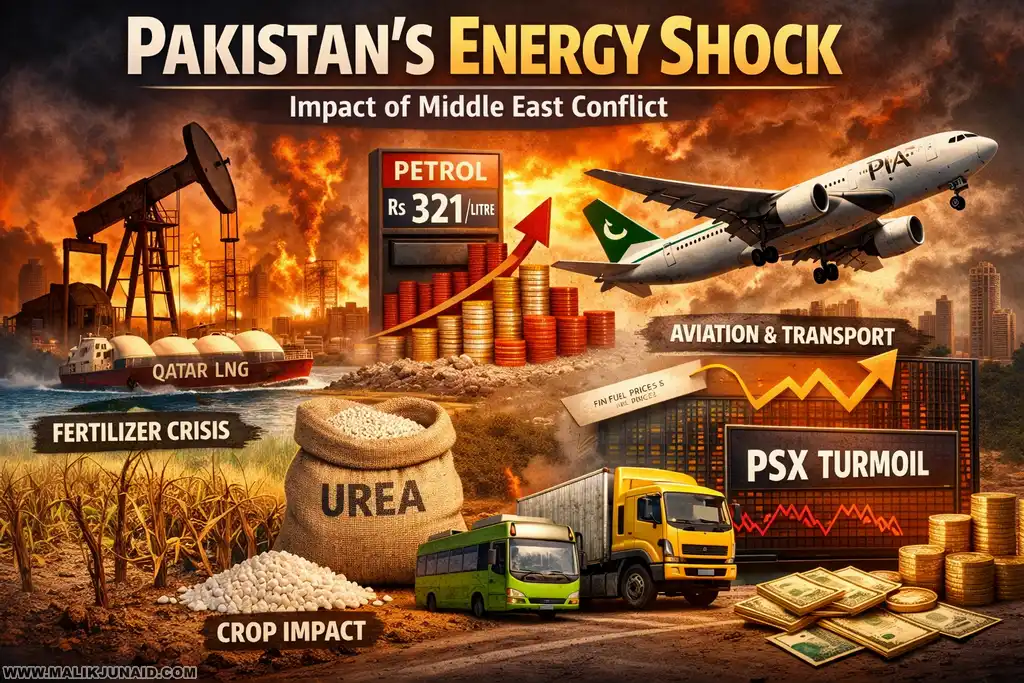
The Middle East conflict has pushed energy back to the center of Pakistan’s economic story. Brent crude briefly moved above $119 a barrel in early March, while Pakistan responded by raising petrol prices by Rs55 per litre, taking petrol to Rs321.17 and diesel to Rs335.86. At the same time, disruption to Qatari LNG has raised fresh concern about Pakistan’s gas security, even though officials say the power system is less exposed than it was during the 2022 crisis.
That matters because energy shocks rarely stay inside the oil market. In Pakistan, they spill into inflation, freight, industrial margins, fertilizer production, electricity planning, airline costs, and stock-market sentiment. The State Bank of Pakistan has already pointed to rising global energy prices as a risk to inflation and growth, holding its policy rate at 10.5% on March 9, 2026, partly because imported energy volatility has clouded the outlook.
This article breaks down how the current energy shock could ripple through three critical sectors: fertilizer and agriculture, aviation and transport, and financial markets. It also explains why real-estate investors, developers, and end-users should pay attention, especially in growth corridors around Islamabad and Rawalpindi where infrastructure costs, transport economics, and investor confidence shape demand. For readers tracking long-term investment zones, official updates from Capital Smart City, the project’s introduction page, and its Rawalpindi Ring Road impact analysis remain useful for understanding how macro shocks can influence local property sentiment.
Why this energy shock is different for Pakistan
Pakistan is an energy-importing economy with limited room for policy error. Reuters reported that Pakistan imports most of its oil through the Strait of Hormuz from Saudi Arabia and the UAE, which means geopolitical disruption immediately raises import costs, transport costs, and inflation risks. The government has already shifted to weekly fuel-price reviews and announced austerity measures, including reduced fuel allowances, fewer official vehicles on the road, and shorter public-sector workweeks, to conserve energy and manage the shock.
Gas risk is more nuanced, but still serious. Pakistan’s power minister said on March 13 that LNG now contributes about 10% of electricity generation, mostly for evening peak demand, and that domestic generation has reduced vulnerability compared with past years. Even so, Reuters also reported that Qatar remains Pakistan’s main LNG supplier and that prolonged disruption could still trigger limited load shedding during peak summer demand. Meanwhile, Shell and others have declared force majeure on Qatari LNG-linked cargoes after disruptions at QatarEnergy’s facility, underlining how quickly global gas flows can become a domestic issue.
One important caveat: I could verify the current fuel-price numbers and LNG disruption risk, but not the exact claim that LNG supplies 20–25% of Pakistan’s total gas. Recent verified reporting supports a narrower statement: LNG is strategically important, Qatar is Pakistan’s main LNG supplier, and disruption still matters for peak power and industrial users.
Sector 1: Fertilizer and agriculture face a chain reaction
The fertilizer sector is one of the first places where a gas shock can become a food-price shock. That is because Pakistan’s nitrogen fertilizer production depends heavily on natural gas as feedstock. Official and industry-linked sources describe natural gas as the core feedstock for urea, and Pakistan’s own policy debate has repeatedly focused on how to secure gas for fertilizer plants to protect food security.
The risk is no longer theoretical. Agritech informed the Pakistan Stock Exchange that its urea plant had to suspend operations after RLNG supply was disrupted following a force majeure-linked communication tied to the Middle East conflict. A later market update said full operations were set to resume after RLNG supply was restored, which shows both the fragility of the system and the speed with which gas interruptions can hit fertilizer output.
Globally, Reuters reported that the war has shut fertilizer plants in the region, disrupted shipping routes, and threatened supplies just as farmers in the Northern Hemisphere prepare for planting. That matters for Pakistan in two ways. First, any domestic gas shortage can curb local urea production. Second, any international fertilizer squeeze can raise import costs and tighten availability. Either channel can feed through to agriculture, especially if farmers face higher urea prices before key crop cycles.
The macro implication is straightforward. Higher fertilizer costs can reduce application rates, squeeze farmer margins, and eventually show up in lower yields or higher food inflation. The SBP has already warned that the energy shock could keep inflation elevated. In an agriculture-heavy economy, fertilizer disruption is one of the clearest ways an oil-and-gas crisis can move from headlines into kitchen budgets.
This is also why energy policy and industrial policy cannot be treated separately. Pakistan’s recent push for alternative feedstock, coal-to-urea projects, and better gas allocation reflects a larger concern: food security depends on fuel security. If the LNG situation remains unstable, fertilizer and agriculture could become the second-round inflation story after petrol.
Sector 2: Aviation and transport are absorbing the shock fast
Aviation is one of the quickest transmission channels for an oil shock because jet fuel moves almost immediately with global energy prices. Reuters reported this week that jet-fuel price increases have outpaced the oil rise since the Iran war began, while airlines globally have responded by raising fares, adding surcharges, and adjusting schedules. Broader Reuters coverage also noted that the war has disrupted Middle Eastern airspace, caused large-scale cancellations, and pushed up jet fuel and airfares.
Pakistan is already seeing this locally. Dawn, citing airline officials and flight data, reported that Pakistan International Airlines raised fuel surcharges on domestic and international flights because fuel costs had risen 34% during the Gulf crisis. That means higher ticket prices for business travel, family travel, cargo-linked trips, and tourism-related movement.
Transport is even broader than aviation. Pakistan’s fuel-price jump to Rs321.17 per litre does not only affect private motorists. It feeds directly into trucking, intercity bus operations, delivery services, ride-hailing economics, and industrial logistics. Reuters noted that the 55-rupee increase was the highest on record and warned it could worsen inflation, especially for lower-income households. In a country where road transport carries a large share of goods movement, more expensive diesel and petrol quickly raise the cost of moving food, construction materials, and consumer products.
That has real implications for construction and real estate too. Developers facing higher freight costs for cement, steel, glass, tiles, and electrical equipment will feel margin pressure. End-users may see more expensive commuting and higher service charges in urban projects. Investors tracking growth corridors can study Capital Smart City’s construction updates, the construction policy 2026 in Capital Smart City, and Capital Smart City Interchange materials because infrastructure access, logistics efficiency, and transport links become even more important during fuel shocks.
Transport inflation also changes household behavior. When commuting becomes more expensive, location matters more. Projects with stronger road connectivity, mixed-use planning, or closer access to employment centers often become more resilient. That is one reason investors compare corridors and master-planned communities through pages like Capital Smart City Phase 1, Capital Smart City maps phase 1, Capital Smart City maps phase 2, and Capital Smart City phase 3 location significance.
Sector 3: Financial markets are pricing the geopolitical risk
Pakistan’s financial markets have reacted sharply to the conflict. Reuters video coverage from March 3 described a record fall in Pakistani stocks as investors sold risk assets amid the U.S.-Israel war on Iran. Local reporting from Dawn said the KSE-100 tumbled more than 6% in a single session and triggered a market halt after the KSE-30 fell 5%, underscoring how rapidly global geopolitical risk can hit local valuations.
This reaction makes sense. Pakistan’s equity market is highly sensitive to imported inflation, exchange-rate pressure, interest-rate expectations, and external financing conditions. The SBP explicitly linked higher oil prices to a more uncertain inflation path, and S&P has warned that highly indebted, energy-importing economies such as Pakistan are among the countries most exposed to surging oil and gas prices.
In practical terms, higher oil can hurt listed companies through several channels at once. Manufacturers face higher input and transport costs. Airlines and logistics firms face direct fuel pressure. Consumer demand can weaken if households spend more on energy. Banks may grow more cautious if inflation and rates stay higher for longer. And if foreign investors turn defensive, broader market liquidity can suffer. Reuters’ broader analysis on oil shocks and financial stress argues that energy spikes can reinforce market volatility by worsening inflation expectations and tightening financial conditions together.
For Pakistan, that feedback loop is especially important because economic stabilization is still incomplete. Reuters reported that reserves have improved and the current account posted a surplus in January, but policymakers are still operating inside an IMF-backed adjustment framework. A prolonged oil shock can slow that progress by worsening the import bill and keeping inflation sticky.
What this means for ordinary households
For households, the shock shows up in layers. The first layer is obvious: petrol and diesel become more expensive. The second layer arrives more quietly through more expensive transport, food, and utilities. The third layer appears later if fertilizer shortages hit crop costs, if airlines pass through higher fuel surcharges, or if power outages return during summer peaks.
That is why the government’s response has focused on fuel conservation measures as well as maritime security. Reuters reported that Pakistan launched a naval shipping-security operation to protect sea lanes and energy supplies, while also emphasizing that petroleum reserves remain comfortable for now. That suggests authorities are trying to buy time and maintain continuity rather than signaling immediate panic.
Still, the broader message is that Pakistan remains vulnerable to external energy shocks, even if the electricity mix is gradually improving. Reuters says domestic and clean power now account for a much larger share of the system than before, but LNG disruption can still matter for evening demand and some urban load centers. So the risk has narrowed, not disappeared.
What it means for investors and the property market
Energy shocks are not only a macro story. They also change investor psychology. When oil spikes, buyers start thinking harder about transport access, utility reliability, mixed-use development, and long-term affordability. Real-estate demand often becomes more selective, favoring projects with stronger infrastructure, better planning, and clearer execution. That helps explain why investors increasingly follow development-specific content rather than generic speculation.
For those studying Islamabad-region opportunities, relevant reference points include Capital Smart City Phase 1 videos, Capital Smart City Phase 2 videos, Executive 1 Block C, Executive 1 Block C guide, District One commercial plots, and Capital Smart City Phase 3 future. For a conflict-specific regional property angle, this analysis on Dubai real estate and the Iran war impact is also contextually relevant.
Investors who want project guidance, market interpretation, or end-to-end property assistance can contact Gains Real Estate and Marketing Pvt Ltd through 0333-1003535 or 0335-5592930. For direct messaging, use WhatsApp at 0333-1003535 or 0335-5592930. You can also explore malikjunaid.com, capitalsmartcity.com.pk, capitalsmartcityislamabad.pk, capitalsmartphase3.com, and www.faisaltownphase2.pk. For inquiries, the official Capital Smart City contact page, simple contact form, Capital Smart City Islamabad contact page, and Capital Smart City Phase 3 contact page are the most relevant starting points.
Final word
Pakistan’s latest energy shock is not just about one week’s petrol price. It is a stress test for the country’s inflation outlook, fuel-import dependence, fertilizer security, airline economics, and market confidence. Verified reporting shows that oil surged above $119 a barrel at the peak, Pakistan raised petrol to Rs321.17 per litre, the SBP paused further easing because of energy-led inflation risks, and LNG disruption from Qatar remains a live concern even if power-sector exposure has declined.

Recent Posts
Faisal Town 2 Model Block Location | Payment Plan | NOC

All Categories
- : faisal-hills-plot-for-sale
- 1 Kanal Balloted Plot for Sale – Overseas Central Sector C, Capital Smart City
- 1 Kanal Plot for Sale in Capital Smart City Phase 1 — Overseas Prime-1 Sector H (Access Road 1)
- 1 Kanal Plot for Sale in University Town Islamabad – Prices, Houses & Property Guide
- 1 Kanal Plot in Capital Smart City Phase 1 – Overseas Prime 1 Block
- 1 Kanal plot in Overseas Prime 1
- 1 Kanal Residential Plot for Sale in Faisal Town Phase 2
- 10 Marla 6-bedroom house for sale located in Capital Smart City – Overseas East Block C
- 10 Marla Plot for Sale Capital Smart City Islamabad Sector A Overseas East Block
- 10 Marla Plot for Sale in Executive West – Capital Smart City
- 10 Marla Villa for Sale – Capital Smart City Phase 1 (Overseas East)
- 2 Kanal Plot for Sale in Capital Smart City Overseas Prime 1
- 4 marla commercial plot for sale in Capital Smart City Overseas Central – Sector A
- 5 Marla Executive west G Block Plots for Sale in Capital Smart City phase 2
- 5 Marla Plot Available in Faisal Town Phase 2 Resale
- 5 Marla Plot for Sale in Capital Smart City – Overseas East | Sector E
- 5 Marla Plot for Sale in Capital Smart City | Overseas East E Sector
- 5 Marla Plot in Executive 1 Sector C
- 5 Marla plot in Overseas East, Sector H, Street 6 Capital Smart City Phase 1
- 5 marla Residential Plot for Sale in Capital Smart City – Overseas West
- 7 Marla Corner Plot in Overseas Prime Block E – Fully Paid Prime Location Zero Dues!
- 7 Marla Plot for Sale – Capital Smart City Phase 1 Executive Block B
- 7 Marla Villa in Capital Smart City Overseas East Sector E
- 8 Marla Commercial Plot for Sale – Capital Smart City Overseas East phase 1
- apna ghar apni chat
- apna ghar apni chat scheme
- best investment in Pakistan, Faisal Town Phase 2, Faisal Town Phase 2 Islamabad
- Best Sector in Faisal Town Phase 2, Faisal Town Phase 2
- blue world city
- Blue World City Islamabad: Navigating Installment Demands without NOC Approvals
- Capital Smart City – Executive Block (Phase 1): In‑Depth Guide to 5‑Marla Plots in Sectors B & C
- Capital Smart City – Overseas Central (Harmony Park) Sector H, Plot #36 | 3.5 Marla Fully Paid & Possession Ready
- Capital Smart City – Overseas East (Sectors E, F, G)development status
- Capital Smart City 14th August 2025 – A Grand Jashn-e-Azadi Celebration
- Capital Smart City 5 Marla House | Step-by-Step Construction Guide | Part 1: Taking Possession
- Capital Smart City Authorized Dealers List
- Capital Smart City Booking 2026: Phase 2 & Phase 3 Guide
- Capital Smart City Dealers in Islamabad
- Capital Smart City Distance Guide
- capital smart city executive sector b
- Capital Smart City Harmony Park Guide
- capital smart city interchange
- Capital Smart City Islamabad
- Capital Smart City Islamabad Construction bylaws Malik Junaid Gains Real Estate
- Capital Smart City Islamabad YouTube
- Capital Smart City Overseas Block Prices
- Capital Smart City Overseas Central Sectors E & B drone walkthrough 2025
- Capital Smart City Overseas East – Complete Guide, Updates, and Investment Insights
- Capital Smart City Overseas East | Sectors E, F & G
- Capital Smart City Overseas East drone update 2025
- Capital Smart City Overseas East Map PDF – Complete Guide & Map Overlay
- Capital Smart City Overseas East plot for sale
- Capital Smart City Overseas East Sectors A, K, J, B – Complete Tour & Plot Guide 2025
- Capital Smart City Payment Update & Limited-Time Discounts (Aug–Sept 2025): What Every Member Should Know
- Capital Smart City Phase 1 full overview
- Capital Smart City Phase 1 vs DHA Gandhara Phase 9
- Capital Smart City Phase 2 Plot Relocation Guide
- Capital Smart City Phase 3 – Pre-Launch Residential Plots with Exclusive Discounted Payment Plan (4.5 Years Installments)
- Capital Smart City Phase 3 Booking
- Capital Smart City Phase 3 Launching Soon: Location, Prices & Investment Potential
- Capital Smart City Phase 3 NOC
- Capital Smart City Phase 3 vs Faisal Town Phase 2
- Capital Smart City Villa Apartments — FDH Special Relief & Escalation Discount Details (Sept 2025)
- Capital Smart City Villa Apartments: Price & Plan
- Capital Smart City vs Faisal Town Phase 2: Which Is Better in 2026?
- Capital Smart City West Block Map Guide
- Capital Smart City WhatsApp Group – Join for Latest Updates & Investment Insights
- CDA Sector I-16 Islamabad
- Chahan Dam La Mer District Capital Smart City
- Chahan Dam views in Capital Smart City (CSC)
- Commercial for sale in Capital Smart City Executive West
- Commercial Plots & Land for Sale in Faisal Town Phase 2 Islamabad
- complete society 4k drone view
- CSC Balloted Plots vs DHA Gandhara 1 Kanal
- CSC NOTIFICATIONS
- DHA Gandhara (DHA Phase 9 Islamabad) Drone Tour 4K | Location, Access & Latest Update
- DHA Gandhara Installment Plots Near Capital Smart City
- DHA Gandhara Map: View Tentative E-Map
- DHA Gandhara Map: View Tentative E-Map and Land Overlay
- DHA Phase 5 Islamabad
- Dha Phase 5 Islamabad Plot Prices
- Downtown Commercials in Capital Smart City
- Drone Footage of Capital Smart City Pakistan – Overseas East (Sector C)
- Drone Video Capital Smart City Overseas East Block
- Dubai Property Market War Impact and Effect on Pakistani Real Estate Investments
- E Map University Town Islamabad – Location Map, Plots & Sector Guide
- Executive 1 Block C Capital Smart City
- Executive 1 Block C Capital Smart City Islamabad
- Executive 1 Sector B – Capital Smart City Phase 1
- Executive 1 Sector B villas Capital Smart City drone tour
- Executive Sector B
- Executive Sector B Capital Smart City Phase 1
- Executive West Capital Smart City Phase 2 2025
- Executive West Development | Capital Smart City Phase 2 (September 2025)
- Explore E-18 & D-18 Islamabad – Gulshan-e-Sehat & Engineering Cooperative Housing Societies
- faisal hills
- faisal hills a block map
- faisal hills contact number
- Faisal Hills Executive Block Map
- Faisal Hills Islamabad
- Faisal Hills Islamabad plots and apartments
- Faisal Hills Location, Plot Price, Payment Plan 2025, NOC & Houses for Sale
- faisal hills news
- Faisal Hills Plots for Sale, Maps, Blocks, Payment Plan & Houses Guide
- Faisal Hills Taxila Complete Guide – Maps, Prices, Plots & Development 2026
- Faisal Hills Taxila Map and Plots
- Faisal Town 5 Marla With Development Charges On 4 Years Installment Faisal Town Phase 2
- Faisal Town Islamabad
- Faisal Town Phase 2 Analysis: FIRs, NAB Inquiry, Land Issues & Investor Risks Explained
- faisal town phase 2 islamabad
- Faisal Town Phase 2 Islamabad – Location, Map, Payment Plan, Latest Updates & Investment Guide
- Faisal Town Phase 2 Islamabad – Location, Maps, Payment Plan & Investment Guide
- Faisal Town Phase 2 Islamabad – Location, Payment Plan, Balloting, Price List & Plot for Sale
- Faisal Town Phase 2 Islamabad – Map, NOC Status, Location, Investment Analysis
- Faisal Town Phase 2 Islamabad Location Map Payment Plan NOC and Investment Guide
- Faisal Town Phase 2 Islamabad Overseas Block
- Faisal Town Phase 2 Islamabad: Investment Opportunities, Comparisons & Analysis
- Faisal Town Phase 2 master plan
- Faisal Town Phase 2 or DHA Gandhara Phase 9
- Faisal Town Phase 2 Payment Plan
- Faisal Town Phase 2 Price Revision Expected
- Faisal Town Phase 2 Sector 0
- Faisal Town Phase 2 Sector O booking available
- Faisal Town Phase 2 Sector O development
- Faisal Town Phase 2 Sector O Model Block Commercial Plots
- Faisal Town Phase 2 Sector O: Plots, Prices & Guide
- Faisal Town Phase 2 Sector X Location
- Faisal Town Phase 2 Sports City 2, Sector I & J, Education District development update
- Faisal Town Phase 2 vs Faisal Town Phase 1
- faisal-hills-location
- faisal-town-islamabad
- Files in Capital Smart City Phase 2
- FOR SALE – COMMERCIAL PLOT (CAPITAL SMART CITY)
- full society visit
- Ghauri Town Phase 7 Encroachment Operation
- House for Sale in University Town Islamabad – Prices, Location, Plots & Investment Guide
- Houses Available on Zameen.com in Capital Smart City
- How Can Pakistanis Residing Overseas Book a Plot in Faisal Town Phase 2
- I-14, I-15, I-16 Islamabad
- i16 sector cda islamabad
- Introducing DHA Gandhara Phase 9 Islamabad’s Next Landmark Destination
- Is it safe to invest in Faisal Town Phase 2
- Karachi Pakistan Zip Code
- Latest Plots for Sale in Capital Smart City Islamabad June 2025 Update
- New Booking for Overseas Central – Ready to Construct Residential Plots
- News
- notifications
- OLX University Town Islamabad – Plots, Houses for Sale & Property Guide
- Overseas Central Sector A B Capital Smart City 2025
- Overseas Central Sector A Big Roundabout Capital Smart City
- Overseas Central Sector E & F drone video
- Overseas Central Sector G Capital Smart City 2025
- Overseas Central Sectors A & B Capital Smart City drone reveal
- Overseas East Ring Road & Access Roads to Overseas Prime – A Game-Changer in Connectivity (Sept 2025)
- Overseas East Sector H Capital Smart City drone 2025
- Overseas Prime 2 Capital Smart City Phase 2 2025
- Overseas Prime Sector H Capital Smart City
- Overseas Prime Sectors D E F Capital Smart City
- Pakistan Real Estate Guide: Finding Property in Pakistan Through Zameen and Modern Housing Projects
- Park View City Islamabad
- Plot for sale Block B Executive 1 Street 3 Plot 17 Capital Smart City
- plot for sale in faisal town phase 2
- Plot for sale in Street No.06, Sector D (Overseas Prime) | Capital Smart City
- plots for sale in Capital Smart City Phase 2 – Overseas West.
- plots for sale in faisal town phase 2
- Plots for Sale in Faisal Town Phase 2 Islamabad
- Prime-1 to Overseas East road Capital Smart City
- property finder
- Property for Sale in Pakistan – Faisal Town Phase 2 Islamabad Real Estate Guide
- Rawalpindi Ring Road Is Changing the Market – What It Means for Faisal Town Phase 2 Prices
- Rawalpindi Ring Road, RRR,
- Real Estate Investment in Pakistan
- Realtors Enclave & 400-ft Main Boulevard | Capital Smart City (Overseas Central) — 2025
- Restaurant
- Role of Marketing in Faisal Town Phase 2 Success
- sale purchase in capital smart city
- Sector E Overseas Central Capital Smart City location
- Sector E, Overseas East: 5 Marla Plot for Sale
- Sector H Land Cutting Revealed! | Capital Smart City Overseas Prime Islamabad Progress
- Shortlisting Plots in Capital Smart City’s Overseas Central – Sectors E & B
- Silicon District Capital Smart City development update 2025
- Soil Testing Map Designing and Modern Construction Solutions in Capital Smart City by Gains Real Estate
- sports facilities Capital Smart City property guide
- This Road connects major sectors of overseas central especially sector g in overseas central
- Today’s Onground Situation of Faisal Town Phase 2
- Top City Islamabad
- Uncategorized
- Understanding the Real Estate Market in Pakistan: A Deep Dive into Zameen.com and Capital Smart City Islamabad
- University Town Islamabad
- University Town Islamabad development
- University Town Islamabad Map PDF Download – Location Map, Master Plan & Plot Guide
- University Town Islamabad Office Sealed – What It Means for Plot Owners & Investors
- University Town Islamabad Plot Prices 2026 – Latest Rates, Map, Sectors & Investment Guide
- University Town Islamabad Sector F, Sector D & Commercial Area – Development Update & Investment Guide
- villas
- War Situation in UAE & Its Impact on Pakistan Property Market – Investor Analysis
- what is property dc valuation
- When Will Life Truly Begin in Capital Smart City Islamabad?
- Where Faisal Town Phase 2 meets Capital Smart City (Thalian Interchange, M-2 & RRR corridor)
- Who is the Owner of Faisal Town Islamabad? Background of Faisal Town Phase 2 & Chaudhry Abdul Majeed
- Why Capital Smart City Is a Safe Option
- X Block Rates Faisal Town Phase 2
- Zameen.com Capital Smart City Islamabad Houses for Sale
- Zameen.com Plot Finder Capital Smart City Islamabad
- 🏡 12 Marla Corner Residential Plot for Sale in Capital Smart City – Overseas Central (Sector A)
Tags
Get Free Consultations
About your file or plot already purchased and what you want to do with it, get a free advice....