

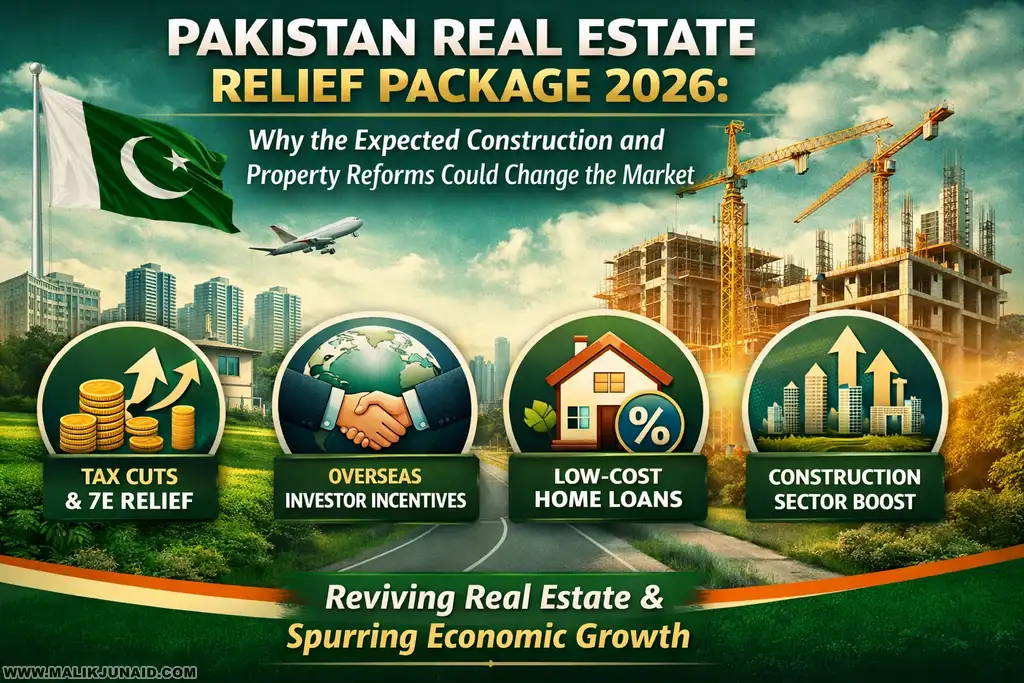
Pakistan Real Estate Relief Package 2026: Why the Expected Construction and Property Reforms Could Change the Market
Pakistan’s real estate and construction sector may be standing at the edge of a major policy reset. After months of pressure from builders, developers, investors, and housing stakeholders, the government is now widely expected to move forward with a Real Estate & Construction Relief Package aimed at reviving property transactions, unlocking housing finance, attracting overseas Pakistanis, and restoring confidence in a sector that touches nearly every corner of the economy. Recent reporting shows the government is finalising recommendations, reviewing tax rationalisation, consulting stakeholders, and simultaneously working on a broader mortgage-finance ecosystem for housing.
If this package is announced in early April 2026, and if the most discussed proposals make it through, it could become one of the most important policy developments for the Pakistan property market, construction boom, overseas Pakistanis investment, and housing sector revival in recent years. More importantly, it would signal that policymakers finally understand a basic truth: when real estate moves, a wide range of allied economic activity begins to move with it, from cement and steel to transport, electricals, glass, paint, fittings, banking, and legal services. Pakistan’s official and policy literature consistently points to construction’s links with multiple allied industries, even if public estimates vary on the exact number.
Why this package matters so much in 2026
The biggest problem in Pakistan’s real estate market has not only been slow demand. It has been uncertainty. Buyers are unsure about taxation. Sellers are hesitant because transaction costs have become too high. Overseas Pakistanis often want to invest, but documentation fears, valuation distortions, and compliance hurdles push them toward caution. At the same time, genuine homebuyers remain squeezed because housing finance is still too limited for the scale of the country’s need. That is exactly why the current policy conversation matters.
The finance minister publicly said in February that the government was preparing relief for the construction sector and seriously considering lower tax rates for the property sector. Since then, the policy direction has become even clearer: the prime minister has been briefed that legal reforms are in their final stages, a low-cost housing loan system has been implemented for a housing project, banks will be given lending targets in the next phase, work is under way on a mortgage-finance ecosystem, and developer-led financing models are also being formed.
That means this is no longer just a tax discussion. It is turning into a broader real estate reform, housing finance, and construction sector revival agenda.
The proposals everyone is watching
1) No financial monitoring in case of overseas remittances
This is easily one of the most high-impact proposals for overseas Pakistanis. Reporting around the package suggests the government wants a more investor-friendly framework, including a self-declaration style regime to encourage overseas money to come into the property and construction sector without fear of harassment. For many overseas investors, the biggest issue has never been interest in Pakistan. It has been friction, distrust, and uncertainty around scrutiny. A clear, lawful, transparent, low-friction remittance mechanism could meaningfully improve confidence.
2) No 7E
Section 7E remains one of the most controversial issues in Pakistan real estate taxation. As of the latest amended Income Tax Ordinance available from FBR, Section 7E (tax on deemed income) still exists in the law. So if the government abolishes or neutralises it for the sector, that would be a major relief signal for investors, owners, and the wider market. Public reporting also shows that abolition of the deemed income tax has been under active consideration.
Why does this matter so much? Because 7E has come to symbolize the perception that real estate is being taxed in a way that does not always reflect actual cash flow, actual yield, or actual transaction activity. Removing it would not just reduce cost. It would reduce psychological resistance in the market.
3) 236-C reduced to 1.5%
At present, FBR’s official guidance shows filer-rate tax under Section 236C on property sales at 4.5%, 5%, and 5.5% depending on transaction value. That makes the proposal to cut it to 1.5% extremely significant. It would lower the seller’s burden, improve liquidity, and encourage movement in stagnant inventory.
The additional suggestion that only 30% of 1.5% be applied where a property is sold within one year is especially interesting because it tries to stimulate short-term investment, quicker turnover, and faster market activity. Whether or not the exact formula survives, the thinking behind it is clear: policymakers want more transactions, not frozen files and locked capital.
4) 236-K reduced to 0.5%
The same story applies on the buyer side. FBR currently lists filer-rate Section 236K tax at 1.5%, 2%, and 2.5% depending on fair market value. So a reduction to 0.5% would directly reduce entry costs for buyers and make formal transactions more attractive.
This matters because buyers do not evaluate taxes in isolation. They calculate total acquisition cost: transfer charges, documentation, valuation, registration, and future holding risk. Lowering 236-K improves the first decision point: whether to buy at all.
5) No double tax regime
One of the loudest complaints in the property market has been layered taxation that feels repetitive and punitive. A move to eliminate any perception of a double tax regime would be welcomed by both investors and end-users. In practical terms, simpler taxation usually means better compliance, better documentation, and greater willingness to transact through formal channels.
6) Fixed tax for overseas investors
Pakistan has already provided one important concession to eligible overseas Pakistanis: FBR says overseas Pakistanis holding NICOP or POC and meeting non-resident criteria can pay filer rates under Sections 236C and 236K even if they are non-filers. That is an important base. A fixed tax regime for overseas investors would go much further by creating predictability.
Predictability is everything in property investment. Overseas buyers are often less concerned with paying some tax and more concerned with surprise tax exposure, classification uncertainty, and process risk. A fixed, clean framework could unlock a lot of dormant demand.
7) No tax up to 1 kanal plot or house
This proposal has huge emotional and political appeal because it connects directly with middle and upper-middle-income genuine buyers. Reporting already indicates that there are proposals to abolish transaction taxes on the first ownership of a home or plot up to one kanal. If implemented carefully, this could become one of the most widely celebrated steps in the entire package.
The real value here is not just tax relief. It is market signalling. It tells people that residential ownership is not being treated purely as a revenue extraction point.
8) No tax for first-time plot or home owner
This is another highly practical reform. First-time buyers are the lifeblood of sustainable real estate growth. They create genuine occupancy, genuine demand, and healthier downstream development. If Pakistan wants a stronger housing sector, it must reward first-time ownership rather than burden it with excessive front-loaded taxes.
This proposal also aligns with the government’s publicly stated emphasis on housing access and low-income or ordinary citizen affordability. The prime minister has explicitly described housing access as a priority and a right of every citizen.
9) No tax on housing loan
Treating housing finance more fairly is essential if Pakistan wants to shift from a cash-dominated property culture to a financing-supported ownership model. The Express Tribune has reported that one proposal under discussion is to treat housing loan instalments as an expense instead of part of income, which would reduce the tax burden.
That is the right direction. A market cannot scale homeownership if financing itself becomes tax-heavy or structurally unattractive.
The bigger reform story: this package is about financing, not just tax cuts
One of the most encouraging aspects of the current policy conversation is that it goes beyond transaction taxes. Pakistan is finally talking seriously about the architecture that supports a real housing economy.
10) Introduction of REITs, home loans at 5%, and RERA
REITs matter because they formalise investment, pool capital, improve governance, and allow broader participation in real estate growth. In January 2026, SECP announced amendments to the REIT Regulations, 2022 to simplify procedures, improve governance and controls, and increase transparency and visibility for REIT schemes. That gives real substance to any proposal that wants to use REITs as part of a modern real estate reform plan.
A RERA-style framework matters for another reason: trust. Pakistan’s property market needs stronger consumer protection, project accountability, documentation discipline, and dispute reduction. Regulatory clarity always improves long-term investment quality.
As for 5% home loans, recent reporting says the government has already rolled out a revised housing financing scheme with lower rates and a higher loan cap, and the prime minister has been briefed about low-cost loan implementation.
11) Uniform valuation with market rates
This reform may sound technical, but it is one of the most important. A market cannot become transparent if official valuation, transaction valuation, and true market value remain disconnected. FBR already maintains property valuation frameworks, but the long-standing complaint in the sector has been the mismatch between tax valuation and actual market reality. Greater alignment would reduce disputes, under-declaration incentives, confusion, and selective enforcement.
12) Low-cost housing loans at 5%
13) Mandatory bank lending targets
14) Allow developer-led financing models
These three proposals belong together because they all tackle the same core weakness: Pakistan’s housing finance depth is still too shallow. Recent briefings to the prime minister confirm that banks will be given targets in the next phase, mortgage-finance ecosystem work is in full swing, and developer-led financing systems are being formed. Meanwhile, SBP already has a regulatory history of mandatory housing and construction finance targets for banks and recognises exposures linked to REITs and PMRC instruments within that framework.
That means the state is no longer thinking only in terms of “announce relief and hope for the best.” It is beginning to think in terms of pipeline creation: lending channels, market instruments, refinancing support, and developer participation.
15) Mortgage market development through bonds and PMRC strengthening
This is where the reform agenda becomes truly serious. PMRC exists precisely to address long-term funding constraints in housing finance. PMRC states that it issues bonds and sukuks to provide long-term funding to partner financial institutions so they can pass fixed and attractive rates to mortgage buyers, and it sees those instruments as part of bond market development as well.
So when people talk about mortgage market development, they are not speaking in abstract terms. Pakistan already has an institutional base for it. Strengthening PMRC and deepening the mortgage bond market could help banks lend longer and more confidently.
16) Green mortgages and Takaful-based housing insurance
These proposals are forward-looking and smart. Green mortgages can reward energy-efficient housing, lower utility pressure over time, and align with more sustainable urban growth. Takaful-based housing insurance can expand protection in a culturally and financially relevant format. Both ideas make the market look more mature, more bankable, and more inclusive.
17) Uniform property valuation repeated for emphasis
It is telling that uniform valuation appears more than once in the proposal list. That repetition reflects how central the issue is. Without trusted valuation, even good tax cuts can lose impact because buyers and sellers still fear inconsistency. With fair, market-linked valuation, transparency improves, revenue quality improves, and documentation becomes more credible.
What could happen next?
The expectation in the market is that provincial taxes may also see reductions by late April or mid-May 2026, while federal tax changes could be reinforced or broadened in the budget. That remains an expectation, not a confirmed announcement. Still, it fits the broader pattern now visible in policy reporting: some steps can come quickly, while others will likely require budget treatment, legal drafting, provincial coordination, or IMF comfort.
The encouraging part is that the tone has shifted. Instead of treating real estate only as a documentation problem, policymakers appear to be looking at it as a growth platform, a housing platform, a financing platform, and an overseas capital platform.
Final word
If even two-thirds of these proposals are implemented properly, Pakistan could witness a meaningful revival in real estate Pakistan, property investment, construction boom, housing finance, and overseas Pakistanis investment. Lower taxes would help. But the deeper win would be restored confidence, improved transaction velocity, broader homeownership, better formalisation, and more financing access.
For investors, developers, and genuine homebuyers, this is the moment to watch closely. The market does not just need relief. It needs clarity, simplicity, and confidence. This package has the potential to deliver all three.
And yes, there is every reason to stay hopeful. The signals are stronger than they have been in a long time. In sha Allah, if the government follows through with consistency, consultation, and execution, 2026 could become a turning point for Pakistan’s property and construction landscape.
For serious guidance on property investment in Pakistan, Islamabad real estate, and opportunities in leading projects, connect with Gains Real Estate and Marketing Pvt Ltd. You can also explore Capital Smart City, Capital Smart City Islamabad, Capital Smart City Phase 3, and Faisal Town Phase 2. For direct assistance, call 03331003535 or 03355592930, or message on WhatsApp 03331003535 and WhatsApp 03355592930.

Recent Posts

10 Marla Plot for Sale in Bahria Enclave Islamabad – A Complete Investment Guide
All Categories
- : faisal-hills-plot-for-sale
- 1 Kanal Balloted Plot for Sale – Overseas Central Sector C, Capital Smart City
- 1 Kanal Plot for Sale in Capital Smart City Phase 1 — Overseas Prime-1 Sector H (Access Road 1)
- 1 Kanal Plot for Sale in University Town Islamabad – Prices, Houses & Property Guide
- 1 Kanal Plot in Capital Smart City Phase 1 – Overseas Prime 1 Block
- 1 Kanal plot in Overseas Prime 1
- 1 Kanal Residential Plot for Sale in Faisal Town Phase 2
- 10 Marla 6-bedroom house for sale located in Capital Smart City – Overseas East Block C
- 10 Marla Plot for Sale Capital Smart City Islamabad Sector A Overseas East Block
- 10 Marla Plot for Sale in Executive West – Capital Smart City
- 10 Marla Villa for Sale – Capital Smart City Phase 1 (Overseas East)
- 2 Kanal Plot for Sale in Capital Smart City Overseas Prime 1
- 4 marla commercial plot for sale in Capital Smart City Overseas Central – Sector A
- 5 Marla Executive west G Block Plots for Sale in Capital Smart City phase 2
- 5 Marla Plot Available in Faisal Town Phase 2 Resale
- 5 Marla Plot for Sale in Capital Smart City – Overseas East | Sector E
- 5 Marla Plot for Sale in Capital Smart City | Overseas East E Sector
- 5 Marla Plot in Executive 1 Sector C
- 5 Marla plot in Overseas East, Sector H, Street 6 Capital Smart City Phase 1
- 5 marla Residential Plot for Sale in Capital Smart City – Overseas West
- 7 Marla Corner Plot in Overseas Prime Block E – Fully Paid Prime Location Zero Dues!
- 7 Marla Plot for Sale – Capital Smart City Phase 1 Executive Block B
- 7 Marla Villa in Capital Smart City Overseas East Sector E
- 8 Marla Commercial Plot for Sale – Capital Smart City Overseas East phase 1
- apna ghar apni chat
- apna ghar apni chat scheme
- best investment in Pakistan, Faisal Town Phase 2, Faisal Town Phase 2 Islamabad
- Best Sector in Faisal Town Phase 2, Faisal Town Phase 2
- blue world city
- Blue World City Islamabad: Navigating Installment Demands without NOC Approvals
- Capital Smart City – Executive Block (Phase 1): In‑Depth Guide to 5‑Marla Plots in Sectors B & C
- Capital Smart City – Overseas Central (Harmony Park) Sector H, Plot #36 | 3.5 Marla Fully Paid & Possession Ready
- Capital Smart City – Overseas East (Sectors E, F, G)development status
- Capital Smart City 14th August 2025 – A Grand Jashn-e-Azadi Celebration
- Capital Smart City 5 Marla House | Step-by-Step Construction Guide | Part 1: Taking Possession
- Capital Smart City Authorized Dealers List
- Capital Smart City Booking 2026: Phase 2 & Phase 3 Guide
- Capital Smart City Dealers in Islamabad
- Capital Smart City Distance Guide
- capital smart city executive sector b
- Capital Smart City Harmony Park Guide
- capital smart city interchange
- Capital Smart City Islamabad
- Capital Smart City Islamabad Construction bylaws Malik Junaid Gains Real Estate
- Capital Smart City Islamabad YouTube
- Capital Smart City Overseas Block Prices
- Capital Smart City Overseas Central Sectors E & B drone walkthrough 2025
- Capital Smart City Overseas East – Complete Guide, Updates, and Investment Insights
- Capital Smart City Overseas East | Sectors E, F & G
- Capital Smart City Overseas East drone update 2025
- Capital Smart City Overseas East Map PDF – Complete Guide & Map Overlay
- Capital Smart City Overseas East plot for sale
- Capital Smart City Overseas East Sectors A, K, J, B – Complete Tour & Plot Guide 2025
- Capital Smart City Payment Update & Limited-Time Discounts (Aug–Sept 2025): What Every Member Should Know
- Capital Smart City Phase 1 full overview
- Capital Smart City Phase 1 vs DHA Gandhara Phase 9
- Capital Smart City Phase 2 Plot Relocation Guide
- Capital Smart City Phase 3 – Pre-Launch Residential Plots with Exclusive Discounted Payment Plan (4.5 Years Installments)
- Capital Smart City Phase 3 Booking
- Capital Smart City Phase 3 Launching Soon: Location, Prices & Investment Potential
- Capital Smart City Phase 3 NOC
- Capital Smart City Phase 3 vs Faisal Town Phase 2
- Capital Smart City Villa Apartments — FDH Special Relief & Escalation Discount Details (Sept 2025)
- Capital Smart City Villa Apartments: Price & Plan
- Capital Smart City vs Faisal Town Phase 2: Which Is Better in 2026?
- Capital Smart City West Block Map Guide
- Capital Smart City WhatsApp Group – Join for Latest Updates & Investment Insights
- CDA Sector I-16 Islamabad
- Chahan Dam La Mer District Capital Smart City
- Chahan Dam views in Capital Smart City (CSC)
- Commercial for sale in Capital Smart City Executive West
- Commercial Plots & Land for Sale in Faisal Town Phase 2 Islamabad
- complete society 4k drone view
- CSC Balloted Plots vs DHA Gandhara 1 Kanal
- CSC NOTIFICATIONS
- DHA Gandhara (DHA Phase 9 Islamabad) Drone Tour 4K | Location, Access & Latest Update
- DHA Gandhara Installment Plots Near Capital Smart City
- DHA Gandhara Map: View Tentative E-Map
- DHA Gandhara Map: View Tentative E-Map and Land Overlay
- DHA Phase 5 Islamabad
- Dha Phase 5 Islamabad Plot Prices
- Downtown Commercials in Capital Smart City
- Drone Footage of Capital Smart City Pakistan – Overseas East (Sector C)
- Drone Video Capital Smart City Overseas East Block
- Dubai Property Market War Impact and Effect on Pakistani Real Estate Investments
- E Map University Town Islamabad – Location Map, Plots & Sector Guide
- Executive 1 Block C Capital Smart City
- Executive 1 Block C Capital Smart City Islamabad
- Executive 1 Sector B – Capital Smart City Phase 1
- Executive 1 Sector B villas Capital Smart City drone tour
- Executive Sector B
- Executive Sector B Capital Smart City Phase 1
- Executive West Capital Smart City Phase 2 2025
- Executive West Development | Capital Smart City Phase 2 (September 2025)
- Explore E-18 & D-18 Islamabad – Gulshan-e-Sehat & Engineering Cooperative Housing Societies
- faisal hills
- faisal hills a block map
- faisal hills contact number
- Faisal Hills Executive Block Map
- Faisal Hills Islamabad
- Faisal Hills Islamabad plots and apartments
- Faisal Hills Location, Plot Price, Payment Plan 2025, NOC & Houses for Sale
- faisal hills news
- Faisal Hills Plots for Sale, Maps, Blocks, Payment Plan & Houses Guide
- Faisal Hills Taxila Complete Guide – Maps, Prices, Plots & Development 2026
- Faisal Hills Taxila Map and Plots
- Faisal Town 5 Marla With Development Charges On 4 Years Installment Faisal Town Phase 2
- Faisal Town Islamabad
- Faisal Town Phase 2 Analysis: FIRs, NAB Inquiry, Land Issues & Investor Risks Explained
- faisal town phase 2 islamabad
- Faisal Town Phase 2 Islamabad – Location, Map, Payment Plan, Latest Updates & Investment Guide
- Faisal Town Phase 2 Islamabad – Location, Maps, Payment Plan & Investment Guide
- Faisal Town Phase 2 Islamabad – Location, Payment Plan, Balloting, Price List & Plot for Sale
- Faisal Town Phase 2 Islamabad – Map, NOC Status, Location, Investment Analysis
- Faisal Town Phase 2 Islamabad Location Map Payment Plan NOC and Investment Guide
- Faisal Town Phase 2 Islamabad Overseas Block
- Faisal Town Phase 2 Islamabad: Investment Opportunities, Comparisons & Analysis
- Faisal Town Phase 2 master plan
- Faisal Town Phase 2 or DHA Gandhara Phase 9
- Faisal Town Phase 2 Payment Plan
- Faisal Town Phase 2 Price Revision Expected
- Faisal Town Phase 2 Sector 0
- Faisal Town Phase 2 Sector O booking available
- Faisal Town Phase 2 Sector O development
- Faisal Town Phase 2 Sector O Model Block Commercial Plots
- Faisal Town Phase 2 Sector O: Plots, Prices & Guide
- Faisal Town Phase 2 Sector X Location
- Faisal Town Phase 2 Sports City 2, Sector I & J, Education District development update
- Faisal Town Phase 2 vs Faisal Town Phase 1
- faisal-hills-location
- faisal-town-islamabad
- Files in Capital Smart City Phase 2
- FOR SALE – COMMERCIAL PLOT (CAPITAL SMART CITY)
- full society visit
- Ghauri Town Phase 7 Encroachment Operation
- House for Sale in University Town Islamabad – Prices, Location, Plots & Investment Guide
- Houses Available on Zameen.com in Capital Smart City
- How Can Pakistanis Residing Overseas Book a Plot in Faisal Town Phase 2
- I-14, I-15, I-16 Islamabad
- i16 sector cda islamabad
- Introducing DHA Gandhara Phase 9 Islamabad’s Next Landmark Destination
- Is it safe to invest in Faisal Town Phase 2
- Karachi Pakistan Zip Code
- Latest Plots for Sale in Capital Smart City Islamabad June 2025 Update
- New Booking for Overseas Central – Ready to Construct Residential Plots
- News
- notifications
- OLX University Town Islamabad – Plots, Houses for Sale & Property Guide
- Overseas Central Sector A B Capital Smart City 2025
- Overseas Central Sector A Big Roundabout Capital Smart City
- Overseas Central Sector E & F drone video
- Overseas Central Sector G Capital Smart City 2025
- Overseas Central Sectors A & B Capital Smart City drone reveal
- Overseas East Ring Road & Access Roads to Overseas Prime – A Game-Changer in Connectivity (Sept 2025)
- Overseas East Sector H Capital Smart City drone 2025
- Overseas Prime 2 Capital Smart City Phase 2 2025
- Overseas Prime Sector H Capital Smart City
- Overseas Prime Sectors D E F Capital Smart City
- Pakistan Real Estate Guide: Finding Property in Pakistan Through Zameen and Modern Housing Projects
- Park View City Islamabad
- Plot for sale Block B Executive 1 Street 3 Plot 17 Capital Smart City
- plot for sale in faisal town phase 2
- Plot for sale in Street No.06, Sector D (Overseas Prime) | Capital Smart City
- plots for sale in Capital Smart City Phase 2 – Overseas West.
- plots for sale in faisal town phase 2
- Plots for Sale in Faisal Town Phase 2 Islamabad
- Prime-1 to Overseas East road Capital Smart City
- property finder
- Property for Sale in Pakistan – Faisal Town Phase 2 Islamabad Real Estate Guide
- Rawalpindi Ring Road Is Changing the Market – What It Means for Faisal Town Phase 2 Prices
- Rawalpindi Ring Road, RRR,
- Real Estate Investment in Pakistan
- Realtors Enclave & 400-ft Main Boulevard | Capital Smart City (Overseas Central) — 2025
- Restaurant
- Role of Marketing in Faisal Town Phase 2 Success
- sale purchase in capital smart city
- Sector E Overseas Central Capital Smart City location
- Sector E, Overseas East: 5 Marla Plot for Sale
- Sector H Land Cutting Revealed! | Capital Smart City Overseas Prime Islamabad Progress
- Shortlisting Plots in Capital Smart City’s Overseas Central – Sectors E & B
- Silicon District Capital Smart City development update 2025
- Soil Testing Map Designing and Modern Construction Solutions in Capital Smart City by Gains Real Estate
- sports facilities Capital Smart City property guide
- This Road connects major sectors of overseas central especially sector g in overseas central
- Today’s Onground Situation of Faisal Town Phase 2
- Top City Islamabad
- Uncategorized
- Understanding the Real Estate Market in Pakistan: A Deep Dive into Zameen.com and Capital Smart City Islamabad
- University Town Islamabad
- University Town Islamabad development
- University Town Islamabad Map PDF Download – Location Map, Master Plan & Plot Guide
- University Town Islamabad Office Sealed – What It Means for Plot Owners & Investors
- University Town Islamabad Plot Prices 2026 – Latest Rates, Map, Sectors & Investment Guide
- University Town Islamabad Sector F, Sector D & Commercial Area – Development Update & Investment Guide
- villas
- War Situation in UAE & Its Impact on Pakistan Property Market – Investor Analysis
- what is property dc valuation
- When Will Life Truly Begin in Capital Smart City Islamabad?
- Where Faisal Town Phase 2 meets Capital Smart City (Thalian Interchange, M-2 & RRR corridor)
- Who is the Owner of Faisal Town Islamabad? Background of Faisal Town Phase 2 & Chaudhry Abdul Majeed
- Why Capital Smart City Is a Safe Option
- X Block Rates Faisal Town Phase 2
- Zameen.com Capital Smart City Islamabad Houses for Sale
- Zameen.com Plot Finder Capital Smart City Islamabad
- 🏡 12 Marla Corner Residential Plot for Sale in Capital Smart City – Overseas Central (Sector A)
Tags
Get Free Consultations
About your file or plot already purchased and what you want to do with it, get a free advice....